When Dining Expectations Meet Reality
You have planned the perfect getaway to Jim Corbett National Park. The bags are packed, the safari is booked, and the anticipation of escaping city life is already lifting your spirits. Among the many things you look forward to — the forest air, the wildlife sightings, the quiet mornings — the food ranks high. After all, a holiday is as much about what you eat as where you go.
But here is a question worth asking before you book: when you sit down for a meal at your accommodation, will it live up to that expectation?
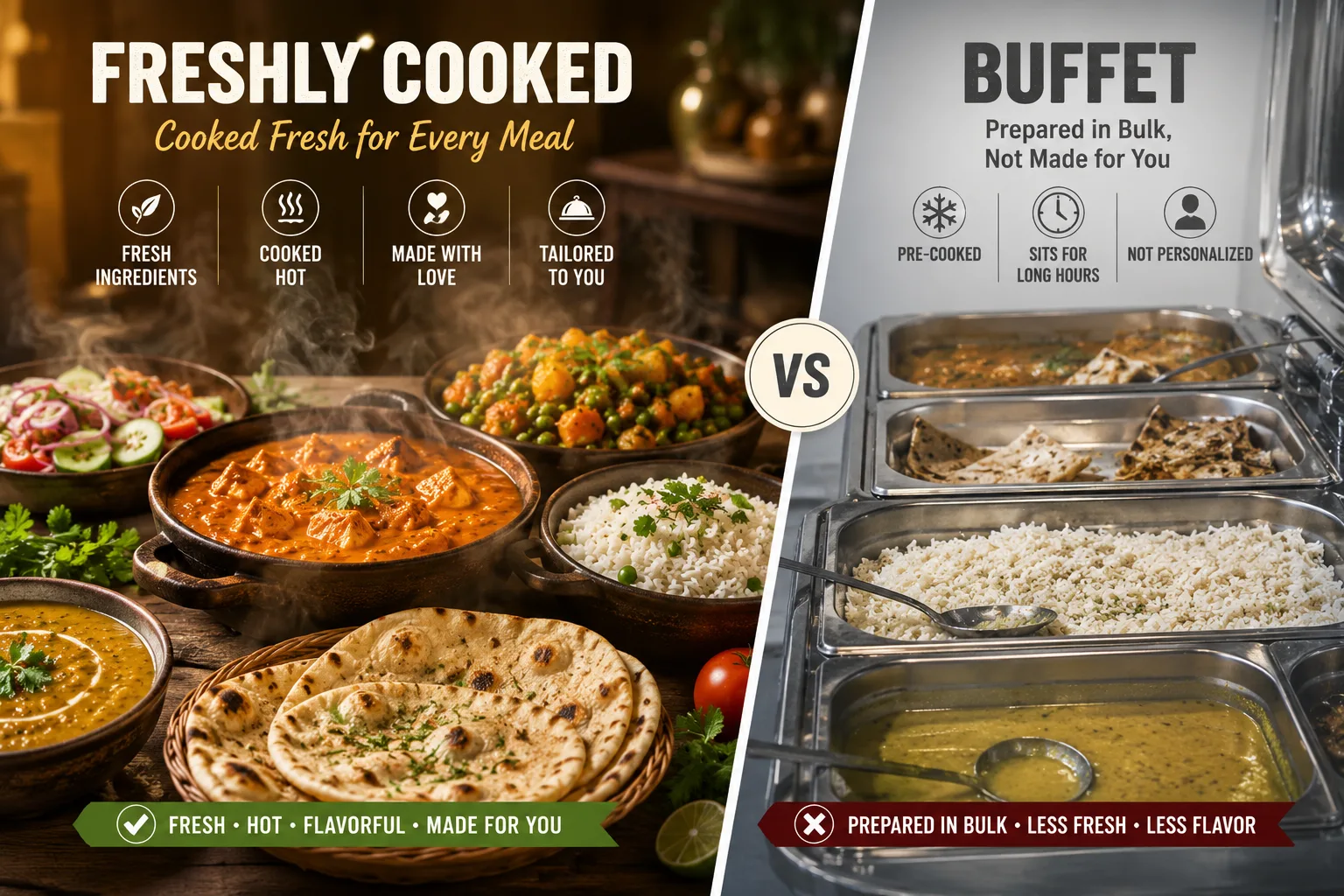
If you have ever stayed at a large resort, you already know the answer. The dining experience typically follows a predictable script. Breakfast, lunch, and dinner are served in a vast hall lined with buffet counters. The spread looks impressive at first — row after row of chafing dishes, salads sweating under heat lamps, and desserts that have been sitting out for hours. But by the second day, the cracks begin to show. The parathas are greasy. The vegetables have lost their colour. The dal tastes like it was made in bulk and reheated. The food is plentiful, but it lacks something essential — the taste of care.
This is not a minor inconvenience. When you are spending your hard-earned holiday time and money, mediocre food becomes a disappointment that colours the entire trip. It leaves you wondering if there is a better way to eat while travelling.
There is. And it begins with freshly cooked food.
The Resort Buffet Problem
Resort buffets are a triumph of logistics over love. To understand why they so often fall short, you need to understand what goes on behind the scenes of a large hotel kitchen.
Cooking for the Crowd
A resort with a hundred rooms may serve three hundred or more guests across two meal shifts. The kitchen must produce enormous quantities of food in narrow time windows. This reality forces compromises at every stage of the process:
Sourcing. When you need to feed hundreds of people three meals a day, you cannot rely on local farms or seasonal markets. You need consistency, volume, and centralised supply chains. The vegetables arrive from wholesale aggregators, often harvested weeks earlier and transported across states. The herbs are dried or powdered, not fresh. The dairy is standardised and pasteurised for long shelf life. The ingredients are chosen for availability and cost, not flavour or nutrition.
Preparation. Bulk cooking changes the way food is made. Gravies are prepared in massive vessels. Vegetables are parboiled in advance and finished in small batches. Spice levels are dialled down to avoid offending anyone’s palate. The cooking becomes a production line — functional, efficient, and utterly impersonal.
Holding. This is where most of the damage happens. Food that tastes wonderful fresh out of the pan deteriorates rapidly under heat lamps and in chafing dishes. Vegetables turn mushy. Fried foods lose their crunch. Rice dries out. The bright green of fresh coriander fades to grey. A dish that was cooked at 10 AM bears little resemblance to itself by 1 PM.
The Illusion of Choice
Resort buffets market themselves on variety. A breakfast spread might offer cereals, fruits, breads, parathas, dosas, eggs made to order, juices, and more. But variety is not the same as quality. Most of those items are prepared from frozen or pre-made bases, designed to be heated and served with minimal effort.
The made-to-order omelette station may seem like a personal touch, but it is a calculated compromise — the resort concedes that eggs cannot survive heat-lamp storage, so it offers limited customisation while keeping the rest of the buffet industrial.
A One-Size-Fits-No-One Approach
The greatest flaw of the resort buffet is its inability to adapt. If you have dietary restrictions — gluten intolerance, lactose sensitivity, a Jain or vegan preference — you are left to pick through the spread and make do. A request for a dish prepared without onion and garlic may be met with helpless shrugs. The kitchen operates on a fixed menu cycle, and deviation is expensive and complicated.
For the traveller who values good food — who sees meals as a highlight of the day rather than a refuelling pit stop — the resort buffet is a compromise that grows more frustrating with each passing meal.
This is precisely why discerning travellers are increasingly turning to boutique farmstays and small-scale retreats. For a detailed comparison of the two accommodation styles, read our guide on farmstay vs resort living near Jim Corbett.
How Freshly Cooked Meals Work at a Boutique Farmstay
At Corbett Foothills Retreat, the approach to food could not be more different. With six rooms and a philosophy that places quality above quantity, the kitchen operates on an entirely different set of principles — principles that begin with the question “what do our guests feel like eating today?” rather than “how many kilos of dal do we need to prepare?”
Cooking to Order, Not in Advance
Every meal at the retreat is prepared fresh. Not in the sense of “assembled from pre-prepped ingredients and reheated” — but genuinely cooked when you order it. Your breakfast parathas are rolled and griddled after you sit down. Your lunch dal is tempered with fresh ghee just before it reaches the table. Your dinner sabzi is stirred to life using vegetables that were on the plant this morning.
This approach requires a different kind of kitchen — one that is responsive rather than industrial. Chefs who understand the rhythm of small-batch cooking. A menu that changes with the season and the market. And a willingness to let guests set the pace rather than forcing them into fixed meal schedules.
Small Batches, Big Flavour
When you cook for six tables instead of six hundred, every detail matters. Spices are freshly ground. Herbs are picked minutes before they are used. The dough for rotis is made by hand, not machine. The curd is cultured in-house.
These are not affectations or marketing points — they are the natural consequences of cooking for a small number of people who value quality. A chef who serves twenty guests in an evening can give each dish the attention it deserves. A chef who must feed two hundred guests is necessarily forced into shortcuts.
The difference is instantly noticeable. Freshly cooked food tastes brighter, smells more inviting, and sits lighter in the stomach. It is the difference between a meal that nourishes and one that merely fills.
Flexible Meal Times
Holidays should not be governed by a restaurant clock. At Corbett Foothills Retreat, meal times are flexible. If you return late from a safari, your lunch is waiting. If you want a leisurely breakfast at 10 AM rather than the standard 8 AM window, it is arranged. This may seem like a small thing, but the freedom to eat when you are hungry — rather than when the buffet opens — is one of the quiet luxuries of boutique hospitality.
The Organic Farm-to-Table Difference
Freshly cooked food is only as good as the ingredients it starts with. This is where the farm-to-table philosophy transforms a meal from good to exceptional.
From Garden to Plate in Hours
At Corbett Foothills Retreat, the kitchen is connected to the farm by a short walk. The organic vegetable garden supplies a significant portion of the produce used in daily meals. Tomatoes are picked at the peak of ripeness. Gourds and leafy greens come to the kitchen with the morning dew still on them. Chillies, coriander, mint, and curry leaves are harvested as needed throughout the day.
The difference between a tomato grown in your own soil and picked this morning versus one that has spent a week in cold storage and travelled five hundred kilometres is not subtle. It is the difference between sweetness and blandness, between fragrance and nothingness. Farm-to-table cooking does not require elaborate recipes or rare techniques. It simply requires good ingredients and the restraint to let them speak for themselves.
Understanding the Organic Promise
Organic farming at the retreat is not a certification sticker — it is a practice rooted in respect for the land. The soil is fed with compost made from kitchen waste and farm residue. Pests are managed through natural methods — neem spray, companion planting, and physical barriers. No synthetic fertilisers or pesticides touch the crops. The result is produce that is not only cleaner and healthier but also more flavourful, because the soil itself is alive and nutrient-rich.
We explore this philosophy in depth in our post on organic farm-to-table dining at Corbett Foothills Retreat. The relationship between healthy soil, nutritious ingredients, and delicious food is one of the most rewarding discoveries our guests make during their stay.
Seasonal Menus
A farm-to-table kitchen does not have a fixed menu because the farm does not produce the same harvest year-round. This is a feature, not a bug. Winter brings peas, carrots, cauliflower, and leafy greens. Summer offers tomatoes, chillies, brinjal, and gourds. The monsoon fills the garden with amaranth, spinach, and the first tender pumpkins.
Each season has its own culinary identity. The kitchen adapts, creating dishes that reflect what the land is offering at that moment. Guests who return in different seasons find a completely different dining experience — one that mirrors the natural cycles of the Kumaon foothills.
Personalisation and Dietary Accommodation
One of the most significant advantages of freshly cooked food in a boutique setting is the ability to personalise every meal. This is not a premium upgrade or a special request — it is the baseline of how the kitchen operates.
Understanding Your Preferences
Before guests arrive, we ask about dietary preferences, restrictions, and allergies. This is not a checkbox on a booking form — it is the starting point for a conversation about food. Do you prefer your food mild or spicy? Are you vegetarian, vegan, or Jain? Do you have gluten or lactose sensitivities? Is there a dish you have been craving?
With this information, the kitchen plans menus that work for you. There is no need to pick around onions in the sabzi or skip the dessert because it might contain dairy. Every element of the meal is designed with your needs in mind.
Cooking That Respects Dietary Choice
In a resort buffet, a “vegetarian section” often means the same dishes as the main spread, minus the meat. At Corbett Foothills Retreat, vegetarian cooking is approached with the same creativity and care as any other cuisine. Our kitchen is well-versed in Jain cooking (no onion, no garlic, no root vegetables), vegan preparations, and gluten-free alternatives using local grains like mandua (finger millet) and jhangora (barnyard millet).
Because meals are cooked fresh, accommodating these requirements does not mean preparing a separate “special” plate while everyone else eats well. It means your meal — regardless of your dietary preference — is given the same attention, the same fresh ingredients, and the same love as every other plate leaving the kitchen.
A Menu That Adapts to You
Have a favourite dish from the first night of your stay? Ask for it again. Want to try something you have never eaten before? The chef will prepare it if ingredients are available. The flexibility extends beyond dietary restrictions into genuine culinary exploration. Our guests often discover new favourite ingredients and preparations during their stay — the result of having a kitchen that treats cooking as a personal service rather than a production schedule.
Connection to Local Kumaoni Cuisine
A holiday in the Kumaon region would be incomplete without experiencing its culinary traditions. The local cuisine of Uttarakhand is simple, earthy, and deeply connected to the ingredients grown in these hills. It is also largely unknown outside the region — a hidden gem waiting to be discovered by travellers who care about food.
The Flavours of the Hills
Kumaoni cooking relies on a handful of staple ingredients — legumes like bhatt (black soybean) and gahat (horse gram), millets like mandua and jhangora, seasonal greens, and the distinctive flavours of local spices like jakhiya (a wild seed used as a tempering agent). The cuisine is traditionally minimalistic, letting the ingredients take centre stage.
At the retreat, our chefs prepare classic Kumaoni dishes alongside familiar North Indian favourites. Guests are introduced to:
- Aloo Ke Gutke — Spiced boiled potatoes tempered with jakhiya and dried red chillies
- Bhatt Ki Churkani — A slow-cooked black soybean curry that is the pride of Kumaoni home cooking
- Chainsoo — A protein-rich black gram preparation roasted and ground before cooking
- Dubke — Soft dumplings of urad dal served in a spiced yoghurt gravy
- Jhangora Kheer — A barnyard millet pudding sweetened with jaggery, representing the dessert tradition of the hills
- Kumaoni Raita — Yoghurt tempered with mustard oil and jakhiya
These dishes are not just menu items — they are windows into a culture shaped by the land, the seasons, and a resourceful people who learned to create rich flavours from simple ingredients. For more on the experiences that define this region, including food trails and village walks, read our guide to things to do near Jim Corbett National Park, which features a dedicated section on tasting the mountains.
Learning Through Food
One of the joys of a boutique farmstay is the opportunity to learn about the food you are eating. Guests are welcome to visit the kitchen, watch the preparation, and ask questions about ingredients and techniques. Our chefs are happy to share recipes and cooking tips that guests can take home.
For those who want a deeper dive, farm walks can be arranged where our staff identify wild edible plants, explain traditional preservation methods (sun-drying, pickling, fermenting), and show you the herbs and spices that define the region’s cuisine. This is food as education — not in a formal classroom sense, but through the natural curiosity that arises when you are close to where your meals come from.
Why This Matters for Your Corbett Holiday
Food is rarely the headline reason people visit Jim Corbett. The wildlife, the forest, the adventure — these are the draws. But food shapes the experience in ways that are easy to underestimate until you stay somewhere that gets it right.
The Rhythm of the Day
A holiday built around freshly cooked meals develops a natural, unhurried rhythm. You wake up when you are rested. You eat breakfast when you are hungry. You return from a morning safari to a lunch that was timed around your return. Dinner is not a rushed affair squeezed between activities — it is a relaxed end to the day, often enjoyed outdoors under the stars with the sounds of the forest around you.
This rhythm is restorative in a way that few travel experiences are. It mirrors the pace of life in the foothills — slow, intentional, and connected to the environment.
Food as Memory
Ask travellers to recall their favourite holiday moments, and food features prominently. The roadside chai on a misty morning. The fish curry eaten by the sea. The market snack discovered in a foreign city.
At Corbett Foothills Retreat, we see the same phenomenon. Our guests remember the taste of just-picked tomatoes in a simple salad. The warmth of a ghee-laden roti fresh off the tawa. The surprising depth of flavour in a Kumaoni dish they had never heard of before. These memories last long after the trip is over.
A Philosophy of Care
The way we approach food at the retreat is not separate from the way we approach hospitality — it is an expression of the same philosophy. Care for ingredients, care for guests, care for the land. When you sit down to a meal that has been thoughtfully prepared with ingredients grown steps away, you feel that care. It is intangible but unmistakable, and it transforms a meal into something meaningful.
To see the farm, the kitchen, and the dining spaces where this philosophy comes to life, browse our photo gallery. And to experience it yourself, explore our room features, which include details about the freshly cooked meals that accompany every stay.
The Value of Fewer Choices Made Well
There is a common anxiety that many guests express before their first boutique stay: “With only a few options on the menu, will I get bored of the food?”
It is a fair question, especially for those accustomed to the sprawling buffets of large resorts. But the answer surprises most guests. By the end of a three- or four-night stay, not a single person has wished for more choices on a buffet counter. Instead, they talk about the meal they did not want to end, the dish they asked for twice, the ingredient they tasted for the first time and now love. This level of personalisation is a hallmark of smaller boutique stays, where kitchen teams have the bandwidth to cook for individuals rather than crowds.
This is the paradox of quality: when a smaller number of dishes are made exceptionally well, they satisfy more than a hundred mediocrities. You eat less, enjoy more, and leave the table feeling nourished rather than stuffed and regretful.
The Bottom Line
The choice between a resort buffet and freshly cooked food is ultimately a choice between two philosophies of hospitality. One prioritises volume, efficiency, and standardisation. The other prioritises quality, personalisation, and a genuine connection between the kitchen and the table.
For your Corbett holiday — a trip already predicated on escaping the ordinary and connecting with nature — the latter approach aligns with everything you are seeking. Good food is not an afterthought. It is an integral part of what makes a holiday restorative, memorable, and worthwhile. The same philosophy of care and authenticity that defines the untold story of Jim Corbett — respect for the land and its gifts — is reflected in how we approach every meal.
At Corbett Foothills Retreat, every meal is an invitation to slow down, savour the moment, and taste the difference that freshness makes. For a broader understanding of what sets boutique hospitality apart, read our post on why choose a boutique stay near Jim Corbett.
Frequently Asked Questions
How is freshly cooked food different from a resort buffet?
Freshly cooked food is prepared to order using seasonal ingredients, often harvested the same day. Resort buffets are cooked in bulk and held under heat lamps for extended periods, which degrades flavour, texture, and nutritional value. Freshly cooked meals offer superior taste, customisation, and a personal connection to the food you eat.
Are dietary restrictions accommodated at Corbett Foothills Retreat?
Yes. Because meals are cooked fresh to order, we can accommodate vegetarian, vegan, Jain, gluten-free, and other dietary preferences with ease. We ask about dietary requirements before your arrival and plan menus accordingly. The kitchen is also experienced with traditional Kumaoni grains like mandua and jhangora that offer excellent gluten-free alternatives.
Is the food at Corbett Foothills Retreat organic?
Our farm follows 100% organic practices — no synthetic fertilisers, pesticides, or genetically modified seeds. A significant portion of the produce used in our kitchen comes directly from our organic garden. We supplement with locally sourced ingredients from neighbouring farms that share our commitment to natural growing methods. You can read more about our approach on our organic farm experience page.
What Kumaoni dishes can I try at the retreat?
Our kitchen regularly prepares traditional Kumaoni dishes including Aloo Ke Gutke (spiced potatoes with jakhiya), Bhatt Ki Churkani (black soybean curry), Chainsoo (roasted black gram), Dubke (urad dal dumplings in spiced yoghurt), and Jhangora Kheer (barnyard millet pudding). These dishes are prepared alongside North Indian favourites, giving guests the chance to explore local flavours while enjoying familiar comfort food.
Are meal times fixed, or can I eat when I want?
Meal times are flexible at Corbett Foothills Retreat. Unlike large resorts with fixed buffet windows, we prepare meals around your schedule. If you return late from a safari, need an early breakfast before a morning walk, or prefer a late dinner after a bonfire, the kitchen accommodates your timings. This flexibility is part of our personalised approach to hospitality.
Will there be enough variety if I stay for several days?
Yes. While the menu changes with the seasons and daily harvest, the kitchen offers a thoughtful rotation of dishes across your stay. Guests can also request specific dishes or preferences. Many guests find they prefer the focused, high-quality variety of fresh cooking over the overwhelming but mediocre spread of a resort buffet. You can also join farm walks and see the day's harvest, which often inspires new dishes prepared just for you.
Can I see the farm and kitchen during my stay?
Absolutely. Guests are welcome to join guided farm walks, visit the organic vegetable garden, and step into the kitchen to watch their meals being prepared. Our chefs enjoy sharing cooking tips, traditional recipes, and insights into the ingredients being used. The farm-to-table journey is transparent from garden to plate, and we encourage guests to explore every step. Our photo gallery offers a preview of the farm and dining experience.
Book Your Freshly Cooked Farmstay Experience
Ready to taste the difference that freshly cooked, farm-to-table meals make on your Corbett holiday? At Corbett Foothills Retreat, every meal is prepared with care using organic ingredients from our farm, tailored to your preferences, and served in a setting that brings you closer to nature.
Browse our accommodation to see the rooms and dining experience that await you, or get in touch to book your stay and let us know about your dietary preferences. We look forward to welcoming you to the table.
Plan Your Stay at Corbett Foothills Retreat
Experience the tranquility of a boutique farmstay with personalised hospitality, organic farm-to-table dining, and easy access to Jim Corbett National Park.