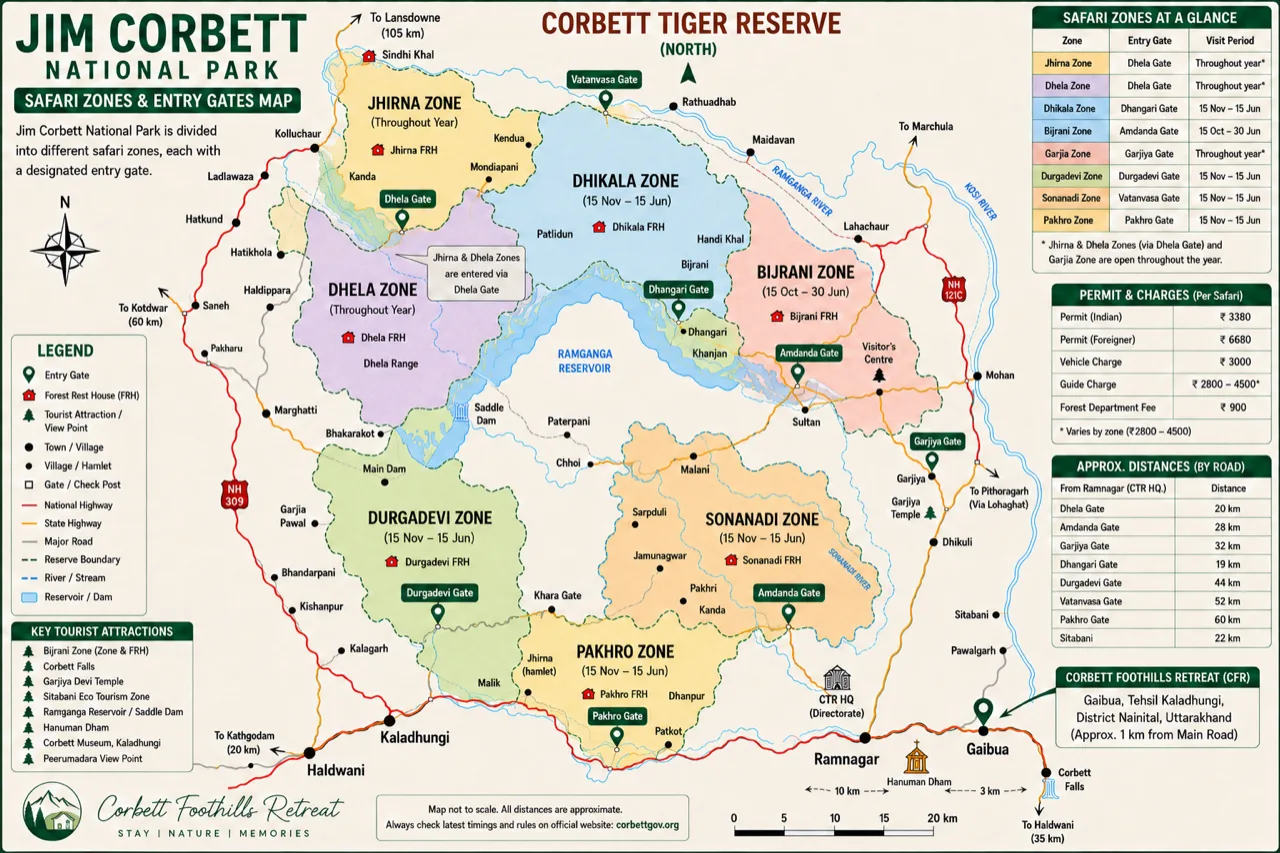
Corbett isn’t one forest, it’s eight. And the zone you pick decides everything: what you’ll see, how much you’ll drive, and whether you’ll book at the right gate.
Most first-time visitors default to the famous names — Dhikala or Bijrani — without checking whether those zones are even open on their travel dates, or whether the landscape suits what they actually want from a safari. That’s how people end up booking weeks in advance and still getting a zone that’s closed, crowded, or wrong for their plans.
This guide breaks down all eight tourism zones of Jim Corbett National Park — what each one offers, when it’s open, and who it’s best for — so you can choose with confidence.
The short answer
If you only read one section, read this.
| Your priority | Best zone |
|---|---|
| Tiger sightings | Dhikala or Bijrani |
| Best for first-timers | Bijrani |
| Open year-round | Jhirna or Dhela |
| Fewest crowds | Sonanadi or Pakhro |
| Monsoon safari | Jhirna or Dhela |
| Birdwatching | Jhirna or Garjiya |
You’ll notice Dhikala keeps topping the list. That’s because it’s the largest, most scenic, and most famous zone in the park. But there’s a catch: Dhikala only opens mid-October to mid-June and requires either a reserved Canter safari or a night stay inside the forest. If that doesn’t fit your trip, Bijrani is the strongest alternative.
For a step-by-step walkthrough of how booking, permits, and gates actually work, read our Complete Guide to Jim Corbett Safari Booking.
The eight zones, at a glance
Each zone has its own gate, its own opening dates, and its own character. Here’s the full picture.
| Zone | Best known for | Open | Best for |
|---|---|---|---|
| Dhikala | Vast grasslands, riverbed, tiger territory | 15 Oct – 15 Jun | Serious wildlife seekers |
| Bijrani | Dense sal forest, strong tiger movement | 15 Oct – 30 Jun | First-timers, photographers |
| Jhirna | Open year-round, varied terrain | All year | Off-season and monsoon trips |
| Dhela | Newer zone, open year-round | All year | Reliable year-round safaris |
| Durgadevi | Riverside terrain, elephant trails | 15 Nov – 15 Jun | Quiet, scenic drives |
| Garjiya | Hill forest on the Kosi, growing activity | 15 Oct – 30 Jun | Birdwatching, short drives |
| Sonanadi | Remote, pristine, low traffic | 15 Nov – 15 Jun | Escaping the crowds |
| Pakhro | Offbeat, riverine, very low traffic | 15 Nov – 15 Jun | Explorers and photographers |
Note: opening dates are set by the Corbett Tiger Reserve each season and can shift. Always confirm the exact dates for your travel window on the official Corbett Tiger Reserve booking website before you plan around a specific zone.
Zone by zone
Dhikala — the crown jewel
Dhikala is the biggest zone in the park, stretching deep into the core area with vast grasslands, dense sal forest, and long stretches of the Ramganga river. This is the landscape Corbett is famous for — the one you see in every documentary.
The grasslands of Maheswari Khali and the open riverbed attract dense tiger, elephant, and deer populations, especially in the late dry season when animals concentrate near water. It also offers the best chance to see species like hog deer that you rarely spot elsewhere in the park.
The trade-off is accessibility. Dhikala is only open from mid-October to mid-June, and you can’t simply book a day jeep into it the way you do other zones. You need either a reserved Canter safari (the shared 16-seater truck) or a night stay in the forest rest house. If you’re a serious wildlife enthusiast and can plan around those requirements, Dhikala is unmatched.
Bijrani — the reliable star
Bijrani is the zone most first-timers should start with. It’s the second most famous zone in Corbett, with a mix of dense sal forest, open grasslands, and gentle rolling terrain that holds good tiger, elephant, and spotted deer populations year after year.
It’s also the most forgiving: access is from the Amdanda gate near Ramnagar, and it runs the classic jeep safari format — a morning and an evening shift, no night stay required. The morning drive is especially beautiful, with soft light filtering through the sal canopy.
Bijrani is the right pick if you want a strong safari experience without the planning complexity of Dhikala. It’s the best all-rounder for families, first-timers, and photographers who want consistent wildlife action.
Jhirna — the year-round workhorse
Jhirna is the only zone that remains open throughout the year, which makes it the default choice during the monsoon months when most other zones shut down. It sits in the southern part of the reserve, with a varied landscape of dry deciduous forest, riverbeds, and scattered teak plantations.
Wildlife here includes tigers, leopards, sloth bears, and a strong population of elephants that move through seasonally. It’s not as scenic as the core zones, but it’s dependable, and its very openness means the animals are used to traffic — sightings are often closer than you expect.
If you’re visiting between July and September, or you want a low-hassle safari that doesn’t depend on exact opening dates, Jhirna is your zone.
Dhela — the newcomer that delivers
Dhela opened to tourists more recently, and it’s quietly become one of the best-value zones in the park. Like Jhirna, it’s open all year round, but its mix of dense forest, bamboo thickets, and open patches gives it a surprisingly high wildlife density.
Tigers are seen here with decent regularity, along with elephants, leopards, and a rich variety of deer. Because it’s less famous than the big two, permits are easier to get — a real advantage on weekends and during peak season.
Dhela is the right pick if you want the reliability of Jhirna but with more forest cover and better odds of a big-cat encounter.
Durgadevi — the quiet riverside zone
Durgadevi is one of the less-visited zones, which is exactly what makes it appealing. Access is from a separate gate on the outskirts of Ramnagar, and the drive takes you through riverine forest along the Kosi, with frequent elephant signs and good habitat for tigers and leopards.
Because it receives far fewer vehicles, the atmosphere is noticeably calmer — the kind of safari where you hear the forest rather than just the other gypsies. It’s a lovely zone for anyone who has already done the big names and wants a more contemplative drive.
One practical note: Durgadevi’s opening dates have varied from season to season, so confirm its exact dates on the official booking calendar before you plan around it.
Garjiya — the underrated bird zone
Garjiya takes its name from the Garjiya Devi temple that perches on the Kosi river, and its zone follows the river through a mix of open scrub and riverine forest. It’s smaller than the others, which keeps the drives short and the wildlife viewing intimate.
It’s a standout choice for birdwatchers — the riverside habitat pulls in kingfishers, herons, barbets, and a wide range of winter migrants — and sightings of elephants are fairly common along the river. Tigers and leopards move through, though they’re seen less often than in the core zones.
If you’re pairing your safari with a visit to the temple, or you want a shorter, gentler drive with excellent birds, Garjiya fits the bill.
Sonanadi — for those who want zero crowds
Sonanadi sits on the western edge of the reserve, and it feels a world away from the busy eastern gates. This is the zone to choose if your priority is emptiness rather than a guaranteed checklist of species.
The forest here is pristine and less disturbed, with a network of streams and quiet valleys that hold tigers, leopards, elephants, and an abundance of birdlife. Safaris feel private, and you’re far more likely to have stretches of the drive entirely to yourself.
The catch is distance and logistics — it’s a longer drive from Ramnagar to reach the gate, and it’s open only from mid-November to mid-June. Plan for a full day, and it’s worth it.
Pakhro — the wild card
Pakhro is the park’s most offbeat zone, a riverine stretch that few visitors have even heard of. It’s open only mid-November to mid-June and receives the lightest vehicle traffic of all the zones.
The landscape is dominated by river islands, grass beds, and dry riverbed — classic territory for tigers and leopards that hunt along the water. You’ll also find deer, wild boar, and a long list of riverbirds. The terrain rewards patience; this is not a zone for one-and-done wildlife spotting.
Pakhro is for explorers who have done Corbett before and want the rare, untouched experience. Bring time, bring binoculars, and expect a safari that feels like an expedition.
So — which zone should you actually choose?
It depends on your dates and your priorities, and most people overthink it. Start with these three questions:
When are you travelling? If you’re going during the monsoon, your options are Jhirna or Dhela — the two zones open all year. If you’re going between mid-October and mid-June, every zone is available.
How much do you want to plan? If you want a simple, classic jeep safari, book Bijrani. If you’re willing to arrange a Canter or a night stay, Dhikala is the ultimate experience.
What’s your priority? Tigers above all → Dhikala or Bijrani. Birds and riverside scenery → Garjiya or Jhirna. Zero crowds → Sonanadi or Pakhro. A year-round safe bet → Jhirna or Dhela.
The decision matrix
| If you want… | Choose | Notes |
|---|---|---|
| The best chance of a tiger | Dhikala | Needs Canter or night stay |
| The best all-round jeep safari | Bijrani | Easy booking, excellent odds |
| A year-round option | Jhirna or Dhela | The only zones open in monsoon |
| The least crowded drive | Sonanadi or Pakhro | Remote, limited window |
| Riverside scenery | Durgadevi or Garjiya | Quiet, beautiful, fewer vehicles |
| The easiest to book | Jhirna or Dhela | Permits are more available |
A word on tiger sightings
No zone can guarantee a tiger. The forest doesn’t run on a schedule, and even Dhikala has quiet days. The best you can do is stack the odds in your favour: book a morning safari (animals are more active at first light), pick a zone with strong prey density, and spend as many shifts as your trip allows.
Patience and realistic expectations matter more than the zone name. And if your dates are flexible, the time of year you visit matters just as much as where you go — our guide to the best time to visit Jim Corbett National Park walks through which seasons deliver the best sightings.
It’s also worth knowing what most visitors don’t expect until they arrive. Our article on What Most Guests Don’t Realize About Jim Corbett Before They Arrive covers the practical surprises that trip people up.
How to turn this into a booking
- Fix your travel dates and confirm which zones are open for them on the official Corbett Tiger Reserve booking website.
- Pick your zone from the matrix above.
- Book early — popular zones and weekend slots go fast, especially from October to February.
- Keep the original ID used at booking; the forest department checks it at the gate.
Choosing the right zone is the single biggest decision in a Corbett trip, but it’s a small one once you know what to look for. Pick your dates, pick your priority, and let the forest do the rest.
If you’re planning to stay nearby, Corbett Foothills Retreat sits just 8 km from the park gates — we can help you plan your safari, arrange pickups from Ramnagar, and set you up with birdwatching and nature walks around our organic farm when you’re not inside the reserve. Find out how to reach us, and check our accommodation or experiences to plan the rest of your stay. For more ideas beyond the safari gates, browse our top things to do near Jim Corbett.
Plan Your Stay at Corbett Foothills Retreat
Experience the tranquility of a boutique farmstay with personalised hospitality, organic farm-to-table dining, and easy access to Jim Corbett National Park.