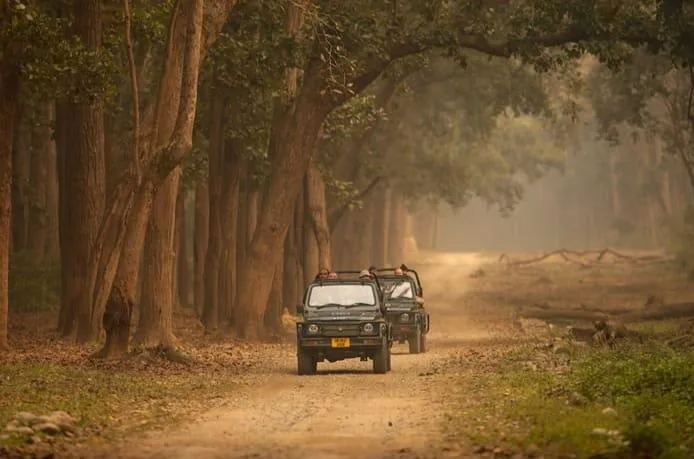
Jim Corbett National Park has a way of appearing in travel dreams long before visitors ever set foot in the Himalayan foothills. The images are familiar: a tiger emerging from tall grass at dawn, elephants crossing a misty river, dense sal forests stretching toward the horizon.
It’s easy to imagine the experience before you’ve lived it.
And that is precisely where the gap between expectation and reality begins.
Every season, guests arrive with certain assumptions about what a Corbett holiday will be like — and many discover, within hours of reaching, that the reality is different from what they’d imagined. Not worse, not better, but different in ways that matter.
Some of these realisations are delightful surprises. Others can be frustrating if you’re unprepared.
This post is written for the traveller who wants to show up knowing what awaits. Not to take away the magic, but to help you arrive with the kind of awareness that turns a good trip into a truly memorable one.
Safari Is Not a Guarantee — Managing Wildlife Expectations
This is perhaps the single most important thing to understand before you book your trip.
A safari in Jim Corbett is not a transaction where you pay and a tiger appears. It is an expedition into a vast, untamed wilderness where animals follow their own rhythms, not human schedules.
Many first-time visitors arrive expecting that every safari jeep returns with a tiger sighting. Social media has amplified this misconception — polished reels and highlight reels show only the thirty seconds of magic, not the three hours of patient driving, scanning, and waiting that preceded it.
The truth is that even the most experienced naturalists and wildlife photographers sometimes complete multiple safaris without sighting a tiger. Corbett is a wild landscape, not a zoo.
A successful safari is one where you immerse yourself in the forest — where alarm calls, pugmarks, bird sightings, elephant herds, deer grazing by the riverbank, and the sheer quiet of the wilderness become the experience. A tiger sighting is a gift, not a guarantee.
For a complete breakdown of zones, timings, booking procedures, and tips for increasing your chances of sightings, read our complete guide to Jim Corbett safari booking. It covers everything from Dhikala’s grasslands to the best times of day for each zone.
The guests who enjoy Corbett most are not those who saw the most tigers. They are those who arrived open to whatever the forest offered.
Seasons Matter More Than You Think
It is easy to assume that any time of year in Corbett will deliver the same experience. It won’t.
The park transforms dramatically across seasons, and the time you choose to visit directly shapes what you see, feel, and experience.
Winter, from October to February, brings cool, crisp mornings and wonderfully pleasant days. This is also the best period for birdwatching — migratory species arrive from as far as Siberia and Central Asia, and the park’s birdlife reaches its peak. The landscape stays lush from the retreating monsoon, making this the most photogenic season.
Summer, from March to June, is hot — temperatures can climb past 40°C. But this is also the season when wildlife sightings peak. Animals gather around water sources, vegetation thins out, and the chances of spotting tigers, elephants, and other species rise considerably. Serious wildlife enthusiasts prefer this window.
Monsoon, from July to September, is quiet — very quiet. Many safari zones close during parts of this season, and travel can be unpredictable. But if you are seeking solitude, dramatic green landscapes, and a slower pace, this is when Corbett reveals its most tranquil face.
Visitors who arrive in winter expecting peak tiger sightings, or those who come in summer without preparing for the heat, often find themselves caught off guard. Seasonality is not a minor detail — it is the single biggest factor in determining what your trip will look like.
For a detailed month-by-month breakdown, read our guide on the best time to visit Jim Corbett National Park.
Getting There Takes Planning
One of the most common surprises for first-time visitors is the journey itself.
Jim Corbett National Park is not the kind of destination where you land at an airport and step directly into the forest. Getting there requires careful planning, and the distance from major cities often takes longer than maps suggest.
The nearest town is Ramnagar, which serves as the main gateway. From Delhi, the drive takes roughly six to seven hours under good conditions — longer if traffic or weather slows things down. The roads leading into the region vary in quality, and the last few kilometres to many accommodations pass through rural village roads that can be narrow and winding.
The nearest railway station is Ramnagar Railway Station, connected by direct trains from Delhi. The nearest airport is Pantnagar, about 80 kilometres away, with limited flight connectivity. For most out-of-state visitors, Delhi remains the most practical starting point.
Many guests underestimate the travel time, especially when arriving late in the evening. Reaching after dark is not ideal — the road conditions, limited lighting, and wildlife movement on roads make night driving less advisable. Arriving before sunset gives you time to settle in, orient yourself, and begin your trip on a relaxed note.
We recommend booking transportation in advance and planning to arrive with enough daylight to spare. Read our detailed guide on how to reach Jim Corbett for route options, train recommendations, and driving tips.
The Park vs the Surrounding Region
Another realisation that dawns on visitors after they arrive is that Jim Corbett is not just a single destination. It is a region — a stretch of the Kumaon foothills that includes the national park at its centre and a ring of villages, forests, rivers, and farms around it.
Many first-time visitors spend all their energy planning the safari and forget to consider what they will do for the rest of their stay. A safari typically lasts three to four hours — that leaves a significant portion of the day to fill.
The surrounding region offers experiences that often become the most memorable part of a trip. Nature walks through village trails, birdwatching along the Kosi River, visits to nearby waterfalls, organic farm tours, cultural interactions with local Kumaoni families, and quiet evenings on the veranda listening to the forest are activities that round out a Corbett visit.
Travellers who treat the park as the sole attraction sometimes leave feeling the trip was incomplete. Those who explore the things to do in Jim Corbett beyond the safari gates discover that the region itself is the real destination.
Accommodation Choice Shapes the Entire Trip
This is a realisation that hits guests within hours of checking in.
Where you stay in Corbett determines not just where you sleep, but the entire texture of your holiday. The difference between a large resort and a small boutique property is not about room size or amenities alone — it is about atmosphere, pace, and the kind of experience you carry home.
Large resorts near the park gates often operate on a volume model — more rooms, more guests, more activities. This works for certain kinds of travellers, particularly large groups or those looking for entertainment-style holidays. But guests who arrive expecting a quiet, nature-immersed retreat sometimes find themselves surrounded by crowds, loud music, and the kind of environment they came to escape.
Smaller properties — particularly boutique farmstays — offer a different experience. With fewer guests, the atmosphere is quieter, the connection to the surroundings is more intimate, and the hosts have the time and attention to shape your stay around your preferences.
Our comparison of a farmstay vs resort explores this choice in more depth. And if you are wondering which approach suits your travel style, our guide on why to choose a boutique stay near Jim Corbett explains what makes smaller properties special for nature-oriented travellers.
The accommodation you choose is not just a place to sleep. It is the environment you return to after every safari, every walk, every meal. It shapes the pace of your days and the quality of your evenings. Choosing wisely makes a significant difference.
Food and Dining Realities
Visitors accustomed to city dining are sometimes surprised by what is — and is not — available near Corbett.
The region is not a culinary hub in the way that hill stations like Mussoorie or Nainital are. The food available at large resorts tends to be standard buffet-style fare designed to feed many guests efficiently. While functional, it rarely reflects the local cuisine or the freshness of ingredients available in the region.
Smaller boutique properties often take a different approach. Because they serve fewer guests, they can focus on quality over quantity. Many source vegetables from local farms or their own organic gardens. Kumaoni dishes — such as bhatt ki churkani (a black soybean preparation), jhangora (millets), aloo ke gutke (spiced potatoes), and gulgula (sweet fried bread) — offer a taste of the local food culture that large buffets rarely include.
Our farmstay vs resort comparison covers the dining difference in more detail, including how the approach to food shapes the overall travel experience.
If you have dietary preferences — vegetarian, vegan, gluten-free, or specific allergies — communicating these in advance to your accommodation helps ensure you are well-fed throughout your stay.
The Cost of Forgetting Small Essentials
A surprising number of guests arrive at their Corbett accommodation and realise they have forgotten something essential.
The region is not a well-stocked urban centre where you can step out and buy whatever you need. Ramnagar has basic shops and pharmacies, but the selection is limited, and many boutique accommodations are located several kilometres from town on rural roads. If you forget insect repellent, sunscreen, a torch, basic medicines, or comfortable walking shoes, you may not find your preferred brand nearby.
Here is a short checklist of items that first-time visitors often overlook:
- Insect repellent — mosquitoes are active, especially near water and during evenings
- Reusable water bottle — carrying plastic bottles into the forest is restricted, and hydration is important during safaris
- Binoculars — many guests rely on cameras alone, but binoculars significantly enhance birdwatching and wildlife viewing
- Torch or headlamp — power fluctuations can happen, and evening walks around your property are more enjoyable with a light source
- Neutral-coloured clothing — bright colours can disturb wildlife and reduce your chances of sightings
- Basic medicines — pharmacies are limited, and common medications for colds, allergies, or stomach upsets are worth carrying
- Comfortable walking shoes — you will likely walk more than you expect, especially if you explore village trails or nature paths
Packing thoughtfully before you leave ensures that small gaps in local availability don’t become frustrations during your stay.
Mobile Connectivity and Digital Realities
One of the most jarring transitions for visitors is the change in mobile connectivity.
Internet access near Corbett is not what most travellers are used to. Data networks can be patchy, especially in areas closer to the forest boundary. Some zones within the park have no connectivity at all. Even at accommodations, WiFi may be slower than city standards, and power fluctuations can occasionally disrupt connectivity.
For some guests, this becomes a source of stress — particularly those who planned to work remotely or stay closely connected to city life.
For others, it becomes one of the most liberating aspects of the trip.
Being forced to disconnect — even partially — creates space for the kind of slow, present-day immersion that Corbett is truly meant for. Mornings without scrolling, evenings without notifications, meals where conversation replaces screens. Many guests who initially feel anxious about limited connectivity later describe it as the most refreshing part of their stay.
A practical tip: download maps, entertainment, and reading material before you arrive. Let your family and colleagues know that your response time may be slower than usual. Embrace the disconnection as part of the experience.
Local Culture and Etiquette Tips
Corbett is situated in the Kumaon region of Uttarakhand, an area with distinct cultural traditions, customs, and a pace of life that differs significantly from India’s metropolitan cities.
Visitors who arrive without awareness of local culture sometimes unintentionally create awkward situations or miss opportunities for meaningful connection.
A few things worth knowing:
- Greeting with warmth goes a long way. A simple namaste or pahari namaskar to local staff, guides, and villagers is appreciated and opens doors to friendlier interactions.
- Dress modestly in village areas. While tourist accommodations are relaxed, the surrounding villages are conservative. Revealing clothing draws unnecessary attention and is best avoided outside resort premises.
- Ask before photographing people. Many locals are happy to be photographed if asked politely. Some are not. Always seek permission first.
- Support local businesses respectfully. Buying from village shops, hiring local guides, and choosing accommodations that employ local staff contributes directly to the community economy.
- Avoid littering. This should go without saying, but plastic waste is a growing issue in the region. Carry a bag for your waste and dispose of it responsibly.
- Respect wildlife distance. Approaching animals too closely, making loud noises, or attempting to feed wildlife is harmful and illegal. Observe from a respectful distance.
Guests who approach the region with curiosity and respect often find that their interactions with local people become among the most memorable parts of their visit. The Corbett region is not just a forest — it is a home to communities whose traditions are deeply tied to the land.
The Quiet That Takes Getting Used To
One of the most unexpected reactions that guests report is the silence.
For travellers arriving from Delhi, Mumbai, Bangalore, or other major cities, the quiet of Corbett can feel disorienting at first. There are no traffic sounds. No constant hum of appliances. No background noise of city life.
What you hear instead — especially in the early mornings and after sunset — is the forest. Cicadas. Birds settling in for the night. The rustle of leaves. A distant langur call. The crackling of a village fire somewhere in the valley.
Some guests find this silence unsettling on the first night. By the second, most describe it as the deepest, most restorative sleep they have had in years.
This quiet is not nothing. It is the sound of a place that has not been consumed by the modern world. Learning to sit with it — without filling it with conversation, music, or screens — is part of what makes a Corbett visit genuinely transformative.
A Final Word Before You Go
Most guests who visit Jim Corbett return with fond memories. But those who return with the deepest appreciation are almost always the ones who arrived with the right expectations. Understanding the hidden costs of mass tourism and the story of how Corbett became a protected landscape deepens the appreciation for what the forest represents.
The forest does not promise a tiger. It does not guarantee perfect weather or seamless internet. What it offers is something rarer: an encounter with a landscape that has existed long before us and will remain long after — if we treat it with care.
Plan your safari thoughtfully. Read the complete safari guide and choose your season wisely. Give yourself time to reach without rushing. Explore the region beyond the park. Choose an accommodation that matches the kind of experience you seek. Consider a boutique farmstay if nature and peace are your priorities. Understand how dining and atmosphere differ between property styles.
And once you arrive, let go of the checklist. Sit on the veranda. Watch the light change over the forest. Listen to the birds. Allow the unhurried rhythm of the foothills to set the pace of your days.
If you are ready to plan your visit to Jim Corbett, Corbett Foothills Retreat welcomes you to experience the region from a peaceful, intimate setting surrounded by nature. For bookings and inquiries, get in touch with us — we would be happy to help you plan a trip that matches what you are truly seeking.
Frequently Asked Questions
Is a tiger sighting guaranteed during a Jim Corbett safari?
No, a tiger sighting is never guaranteed. Jim Corbett is a vast wilderness where animals roam freely. Even experienced wildlife photographers sometimes spend multiple safaris without spotting a tiger. Guests who appreciate the broader ecosystem — elephants, deer, birds, and the forest itself — often leave with richer memories than those focused solely on tiger sightings.
What is the best time of year to visit Jim Corbett?
The ideal time depends on your priorities. October to February offers pleasant weather and excellent birdwatching. March to June provides the best wildlife sightings as animals gather near water sources. July to September transforms the landscape into lush greenery with fewer crowds, though some safari zones close during parts of the monsoon. Read our full guide on the best time to visit for complete details.
How far is Jim Corbett from Delhi, and how do I get there?
Jim Corbett is approximately 260 kilometres from Delhi, and the drive takes around six to seven hours by car. The nearest railway station is Ramnagar, connected by direct overnight trains from Delhi. The nearest airport is Pantnagar, about 80 kilometres away. Our how to reach guide covers all route options, train schedules, and driving tips in detail.
Is there mobile network and internet access near Corbett?
Mobile connectivity can be patchy, especially closer to the forest boundary and within the park itself. WiFi at accommodations is generally available but may be slower than city standards. Many visitors find that limited connectivity becomes a welcome opportunity to disconnect and immerse themselves in the natural surroundings.
What should I pack for a trip to Jim Corbett?
Essentials include insect repellent, a reusable water bottle, binoculars, a torch or headlamp, neutral-coloured clothing for safaris, comfortable walking shoes, sunscreen, and any personal medications you may need. Local shops in Ramnagar have basic supplies but may not carry specific brands or specialised items.
Can I visit Jim Corbett without booking a safari?
Yes. The region around Corbett offers plenty of experiences beyond the park — nature walks, birdwatching, village tours, organic farm visits, riverside picnics, and cultural interactions. Many guests combine a safari with non-park activities for a more rounded trip. Browse our experiences page for ideas on what to do beyond the safari gates.
Is Jim Corbett suitable for families with young children?
Yes, Jim Corbett is family-friendly, but certain precautions help. Early morning safaris can be tiring for very young children. Choose an accommodation with open spaces and child-friendly facilities. Pack snacks, entertainment, and essentials since options near the park are limited. A boutique stay with fewer guests and personalised attention often works better for families than large, crowded resorts.
Plan Your Stay at Corbett Foothills Retreat
Experience the tranquility of a boutique farmstay with personalised hospitality, organic farm-to-table dining, and easy access to Jim Corbett National Park.